



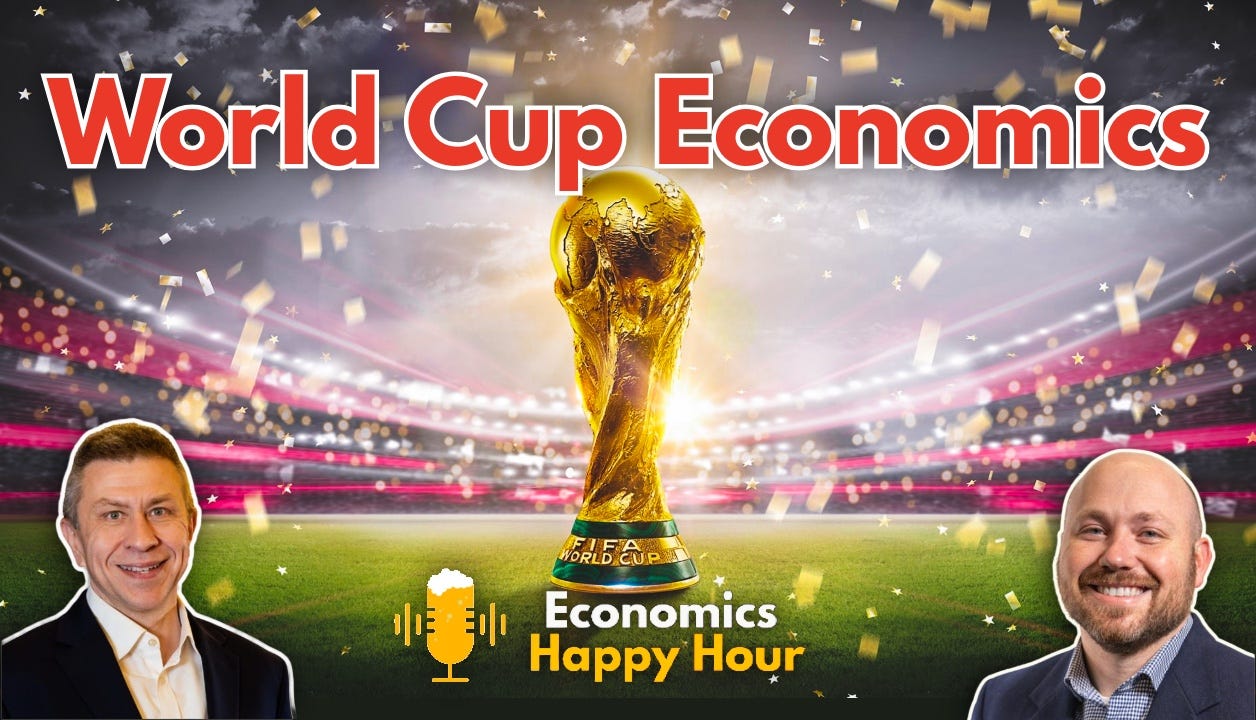
The World Cup has brought millions of international fans to North America, and many are discovering aspects of American life that locals take for granted. Matt and Jadrian explore why visitors are fascinated by things like massive convenience stores, endless product variety, and regional chains. They also dig into the economics behind World Cup ticket prices, player compensation, and the surprising value of hosting global sporting events. Along the way, they discuss how soccer itself is changing as leagues seek new revenue streams.
In this episode, we talk about:
Why World Cup visitors are going viral while discovering everyday American experiences.
How economies of scale help explain Buc-ee’s, giant convenience stores, and product variety.
Whether hosting major sporting events creates meaningful economic benefits.
The economics of ticket prices and why they may not be as outrageous as they seem.
How hydration breaks, advertising revenue, and changing soccer rules could reshape the sport’s future.
If you liked this conversation, you might also enjoy
This Week’s Drinks 🍻
With a morning recording session on a workday, the drinks menu leaned heavily toward breakfast beverages. Jadrian enjoyed a “non-alcoholic mimosa” (also known as orange juice), while Matt powered through with a Diet Mountain Dew that was specifically rebranded as “American Dew 250.”
Name That Stat 📊
This week featured a pair of World Cup-themed statistics. The first number focused on the cheapest resale ticket price available for one of today’s matches. The other looked at the number of World Cup players who were born in a different country than the one they were representing on the field.

Show Notes
With the World Cup underway, one of the most interesting stories hasn’t been happening on the field. Instead, it’s been unfolding across social media as international visitors document their experiences traveling through the United States. Fans have gone viral for their reactions to Waffle House, Taco Bell, giant soda fountains, and especially Buc-ee’s. What seems ordinary to Americans often looks extraordinary to visitors encountering it for the first time.
That observation led to a broader discussion about variety, competition, and economies of scale. Jadrian wrote about this in his Monday Morning Economist newsletter, connecting their experience back to the famous stories about Soviet leader Boris Yeltsin visiting American grocery stores decades ago. While the historical circumstances were very different, both stories revolve around the same reaction: amazement at the sheer number of choices available to consumers.
The Most Important Grocery Store Visit of All Time

Let’s dive into the unexpected legacy of Boris Yeltsin’s 1989 visit to a Houston grocery store. We explore how that moment shaped the Russian leader’s perspective on economic systems and why it's a favorite teaching example in economics classes. It’s a great introduction to consumer choice, abundance, and market economies, thanks to Yeltsin’s astonishme…
From there, we shifted toward the economic impact of hosting events like the World Cup. Economists are often skeptical of exaggerated claims about sports-driven economic growth, but one potential benefit is much harder to measure: positive publicity. The flood of videos showing visitors enjoying American culture may improve perceptions of the United States as a travel destination long after the tournament ends.
We also took some time to explore how ticket prices fit into the broader sports marketplace. While some World Cup matches are commanding hundreds or even thousands of dollars on secondary markets, those prices still look modest when compared to recent NBA Finals tickets. The comparison raises an interesting question about scarcity, prestige, and what people are willing to pay for a once-in-a-lifetime experience.
Finally, one of the most intriguing economic storylines of this summer’s games is the introduction of hydration breaks. Officially designed to give players time to cool down, these stoppages also create opportunities for additional advertising revenue. Will soccer leagues around the world eventually adopt similar breaks now that it’s happening on the game’s biggest stage? The “rules of the game” are always evolving, and the best way to see that is looking back at some of Major League Soccer’s famously strange early attempts to “Americanize” soccer, including countdown clocks, shootouts, and eliminating ties.
We covered a lot of the economics behind the World Cup in this episode, but we’re curious about something a little different, and we’d love your help. If a World Cup visitor came to your hometown or country, what’s the one place, meal, or experience you’d recommend to help them understand what makes it special? Drop your answer in the comments. If we’re ever in your neck of the woods, we just might add it to our itinerary.
Pop Culture Corner 🍿
This week’s recommendation stayed firmly on theme. Jadrian’s recommendation was The Longest Penalty Shot in the World (El penalti más largo del mundo), a Spanish comedy built around an economist’s dream scenario. A backup goalkeeper suddenly finds himself responsible for stopping a championship-deciding penalty kick. Thanks to an unusual twist, the kick won’t happen until the next day. That delay creates endless opportunities for strategy, second-guessing, and game theory. The scene is a fun exploration of interdependence as everyone tries to predict what everyone else will do.
Similarly, there is also a great scene from Ted Lasso involving Nate and AFC Richmond’s coaching staff. The coaches spiral into a chain of “he knows that we know that he knows” logic while trying to anticipate their opponent’s strategy. It’s a perfect pop culture example of common knowledge, strategic thinking, and the recursive decision-making that sits at the heart of game theory.
Have a question or topic idea? Reply to this email or drop it in the comments!


