



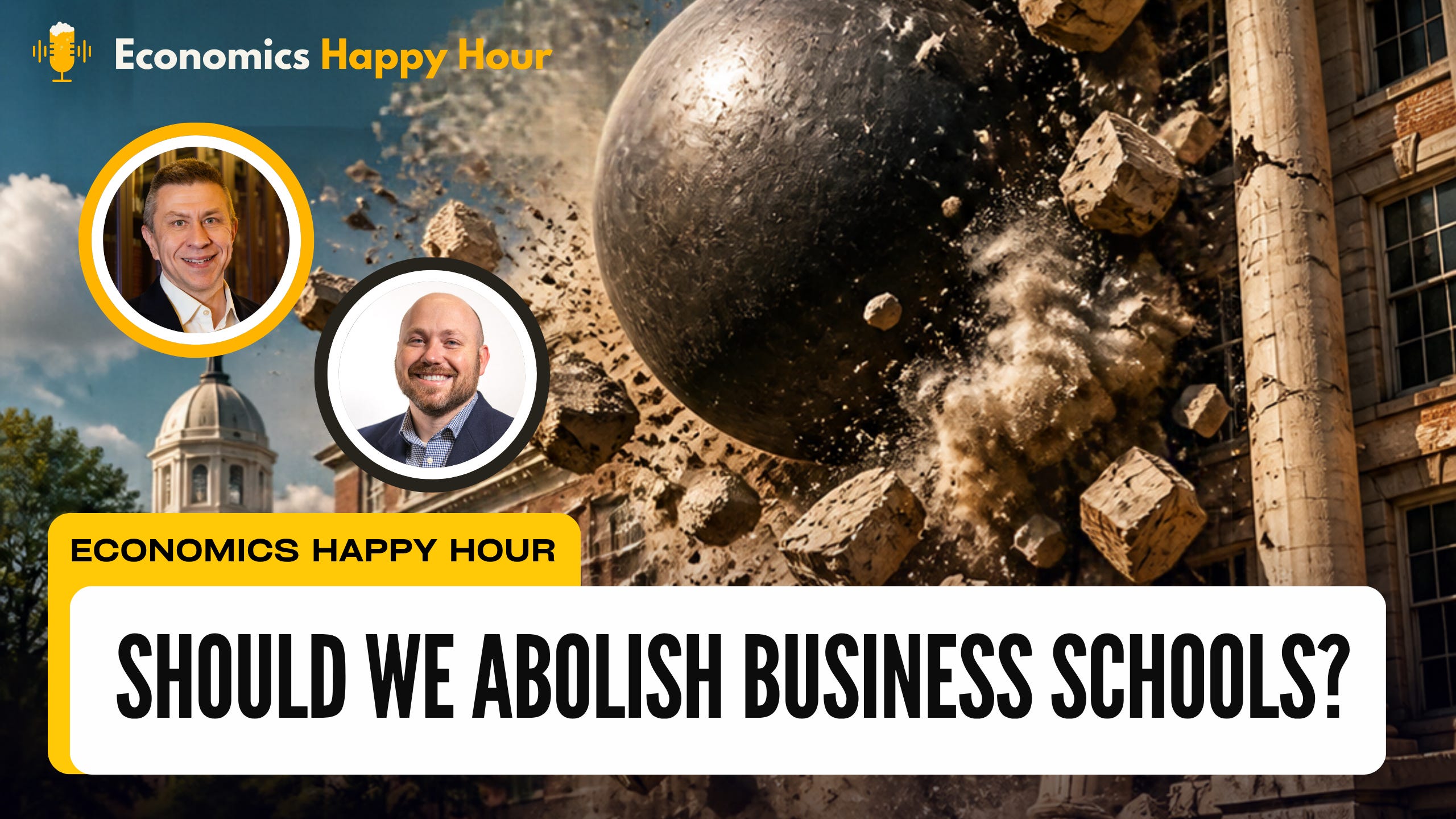
Should universities get rid of their business schools? A recent New York Times OpEd argues that business education encourages students to prioritize profits over the public good, but we’re not convinced the case is that simple. We debate the value of business degrees, the advantages of organizing programs within business schools, and whether universities should rethink how they prepare students for their careers. Along the way, we consider whether business schools are actually doing some things better than the rest of higher education.
In this episode, we talk about:
Whether business schools prioritize private profits at the expense of society.
What business schools offer that other academic departments don’t.
How restrictive degree requirements can limit students’ opportunities to explore other interests.
Whether entrepreneurship and business education contribute to economic growth and improvements in living standards.
What other colleges could learn from business schools about internships, alumni networks, and career preparation.
If you liked this conversation, you might also enjoy
This Week’s Drinks 🍻
We’re keeping things simple this week. Jadrian is working his way through his back-of-the-fridge beer collection with a Sam Adams Breakaway Blonde,. Matt is embracing Oktoberfest season with a Saranac Oktoberfest from a variety pack he picked up a few weeks ago.
Our semesters are going well, with Jadrian finally getting a break from conference travel while Matt has been busy with the AACSB Deans Conference in Orlando. Jadrian will head down to Houston for the Southern Economic Association Meetings while Matt is preparing for a Thanksgiving trip to London with students.
Name That Stat 📊
We’ve got two numbers this week, both connected to business education. Matt looked at how many undergraduate students in the United States are currently studying business. Jadrian pulled data from the Federal Reserve Bank of New York on which business majors had the highest rate of unemployment for recent college grads.
Show Notes
A recent New York Times opinion piece by a professor at the University of Cambridge’s Judge Business School makes a pretty bold argument: it’s time to shut down business schools. The author argues that business education has become too focused on maximizing profits and efficiency while ignoring the broader consequences for society. He worries that students enter college wanting to make the world a better place but leave business school focused on making money instead.
We think there are some legitimate concerns worth considering, but we’re not convinced abolishing business schools is the answer.

There is a question of whether business schools need to exist as separate academic units. After all, students can study economics, statistics, and communication outside a business school. What does a university gain by putting accounting, finance, marketing, and management all together in one unit? A lot of business schools benefit from a shared curriculum, strong alumni networks, mentoring programs, and an emphasis on experiential learning. Those connections can create opportunities that would be harder for individual departments to organize.
But if those benefits are so great for a unit, why don’t other colleges adopt those practices? If business schools are so good at preparing students for careers, shouldn’t the rest of the university be paying attention?
While Matt points to a shared curriculum as a benefit of business education, Jadrian argues that restrictive degree requirements actually harm students’ ability to explore additional interests. Some business schools have so many prescribed courses that there’s little room to explore other disciplines. A student who switches into a business major after a semester or two might need to delay graduation to get through all the requirements. (Matt note: This is not the case at Susquehanna.)
Some universities, including Susquehanna, have recently reduced their business school's required curriculum to give students more flexibility. We both agree that college should be about more than preparing for a first job. Students should have opportunities to discover new interests, pursue minors, and combine their professional goals with subjects they genuinely enjoy. The challenge is finding the right balance between preparing students for careers and giving them room to explore.
But what about the author’s point that business education necessarily makes society worse off? Matt points to the extraordinary decline in global poverty over the past 250 years and argues that entrepreneurship, innovation, and improvements in productivity have played an enormous role in raising living standards. Businesses don’t just create profits for their owners; they also create products, services, and opportunities that benefit consumers and society. (See a letter Matt wrote in response to a similar call to abolish business schools in 2019.)
Ultimately, we find ourselves more interested in improving business education than eliminating it. There are legitimate questions about curriculum design, the role of ethics, the value of case studies, and how much freedom students should have to explore other disciplines. But there are also plenty of things business schools do exceptionally well, particularly when it comes to connecting classroom learning with professional opportunities. Maybe the most productive question isn’t whether we should abolish business schools, but what the rest of higher education could learn from them.
What do you think? If you could redesign the business school at your university, what would you keep, what would you change, and what might you borrow from other academic departments? We’d love to hear your perspective, especially if you’ve studied or taught in a business school. Leave us a comment and keep the conversation going!
After his opinion piece was published, Marquis’ publicist reached out about him appearing on Economics Happy Hour. We decided not to invite him on because we didn’t want the episode to become an opportunity to promote his book, The Profiteers: How Business Privatizes Profit and Socializes Costs.
Instead, we wanted to have our own conversation about the arguments he raised. We’ve linked the article in the show notes, and we invite you to read it, consider his perspective, and decide for yourself whether you want to buy the book.
Pop Culture Corner 🍿
Matt brings us a scene from Game of Thrones featuring Tyrion Lannister and Grey Worm. When Grey Worm expresses distrust of the people they’re dealing with, Tyrion explains that he doesn’t necessarily trust them either, but he does trust their self-interest. It’s a nice connection to one of the central arguments of our episode: people pursuing their own interests can sometimes generate benefits for others. Of course, economists would add an important caveat about having the right institutions and incentives in place.
Jadrian goes with a classic scene from The Office in which Michael Scott visits a business school to share his wisdom with students. Rather than encouraging them to study hard, Michael tears apart a textbook and tells the class that real-world experience matters more than book learning. It’s exactly the kind of advice you’d expect from Michael Scott, and it raises a question that’s surprisingly relevant to our discussion. How much of business education should happen in a classroom, and how much should come from actually working in the business world?
Have a question or topic idea? Reply to this email or drop it in the comments!


