





Artificial intelligence is quickly becoming part of the college classroom, whether instructors are ready for it or not. We talk about how we’re using AI to save time as teachers, from writing better quiz questions to helping us prepare course materials, and how we’ve experimented with bringing it directly into class. But the bigger question is what happens when students use these tools to replace the struggle that’s supposed to lead to learning. We dig into where AI can make students stronger, where it might create shortcuts that hurt them, and how all of this is changing the way we think about teaching.
In this episode, we talk about:
How LLMs can save instructors time on quiz questions, distractors, announcements, and other teaching prep
Bringing AI into class to work through game theory and other economics problems alongside students
The growing divide between students who use AI to build skills and those who use it to avoid building them
Why struggling with a problem is often part of learning, not an obstacle to it
How AI is forcing us to rethink assignments, assessments, and what we actually want students to get out of college
If you liked this conversation, you might also enjoy
This Week’s Drinks 🍻
We recorded this one in the morning, so the drinks looked a little different than usual. Jadrian had coffee with a splash of Buffalo Trace Bourbon Cream, but only because he wasn’t heading straight to work after recording. Matt kept things technically non-alcoholic with Diet American Dew, served in a Michelob Ultra FIFA World Cup cup for a little extra flair.
Name That Stat 📊
Since we’re talking AI in the classroom, Jadrian shared a stat that looked at how common artificial intelligence use was among college instructors. We know the students are using it to help in the classroom, but what about the professors? Matt went in an entirely different direction, with a focus on Broadway revenue. Despite concerns about ticket prices and struggling shows, Broadway is still generating a pretty remarkable amount of money.
Show Notes
AI is already in the classroom, but “using AI in the classroom” can mean a lot of different things. We’re both using LLMs as part of our jobs, especially for the repetitive work surrounding teaching. They’re great for cleaning up clicker questions, generating new versions of questions, suggesting plausible wrong answers for multiple-choice questions, and helping draft announcements. Anyone who has spent too much time trying to invent a fourth believable distractor knows how useful that can be. The important distinction is that much of this happens outside the classroom.
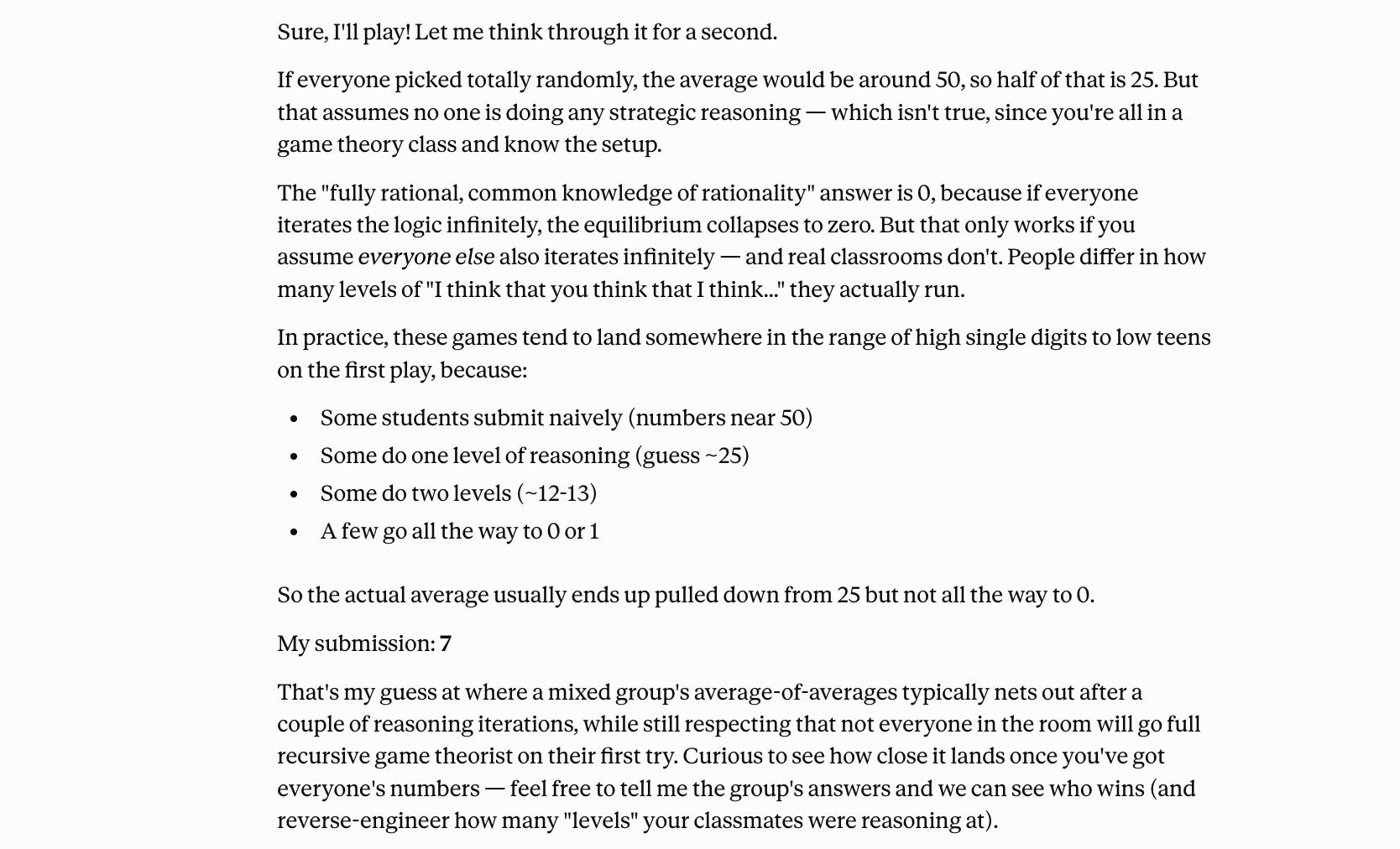
But Matt has actually experimented with putting LLMs in front of students. One example came from his game theory course, when he introduced the classic beauty contest game. Everyone chooses a number, and the winner is the person closest to a fraction of the group’s average. After playing the game with students, he asks the LLM to play along, too. What makes the response interesting isn’t simply whether it lands on the “right” answer. It can explain the equilibrium, recognize that choosing the equilibrium probably won’t actually win against a room full of humans, and reason through how many steps ahead the other players are likely to think. Matt has also done a similar in-class experiment with a coordination game, showing how an LLM could distinguish between the factually correct answer and the answer most likely to be chosen by everyone else.
The harder part of this conversation is what we’re seeing from students. There’s a potentially huge difference between using AI to help you learn and using AI to avoid learning. Strong students can use these tools to go further than they could before. They are asking more questions, exploring new ideas, improving projects, and getting feedback almost instantly. But we’re also seeing students turn to an LLM the second they encounter friction. Give them an ungraded practice problem, and some will immediately ask AI for the answer. Ask them to recall an elasticity formula and, instead of thinking through which version applies, the first instinct can be to ask a chatbot. The answer might be correct, but the thinking that was supposed to happen along the way disappears.
That’s what makes the idea of productive struggle so important. We’ve always had technology that can do things students are supposed to learn to do. Calculators didn’t eliminate the value of knowing multiplication tables. The fact that a tool can produce an answer doesn’t necessarily mean there’s no value in learning how to reach that answer yourself. With LLMs, though, that substitution can happen across a much wider range of tasks. Jadrian has already adjusted some in his small class by only allowing handwritten notes and assigning in-person quizzes. But if students can hand a reading to an LLM and ask for a summary, then we have to think much more carefully about what the reading assignment was supposed to accomplish in the first place.
The part we’re still wrestling with is what this means five or ten years from now. We may end up with students who become dramatically more capable because AI lets them build on an already strong foundation, while others become increasingly dependent on a tool because they never built that foundation at all. That makes this more than a conversation about cheating or whether ChatGPT should be allowed on an assignment. It’s really a question about what learning looks like when getting an answer has become incredibly cheap.
So we’re curious how this is playing out for you. Where have you found AI genuinely helps someone learn, and where have you seen it become a substitute for learning? Leave a comment and tell us what you’re seeing in your own classroom, workplace, or experience with these tools.
Pop Culture Corner 🍿
Matt went back to Fiddler on the Roof and the song “Dear Sweet Sewing Machine,” which celebrates a piece of technology that seems pretty ordinary today. But for a tailor in early-20th-century Russia, a sewing machine represented a major productivity boost: suddenly, you could produce substantially more in the same amount of time.
Jadrian has been rewatching Superstore and highlighted an episode where the fictional retailer rolls out an app that lets customers find products, scan their items, and pay without ever interacting with an employee. Naturally, the workers start wondering: if customers can do all of that themselves, why are we here?
Have a question or topic idea? Reply to this email or drop it in the comments!


