




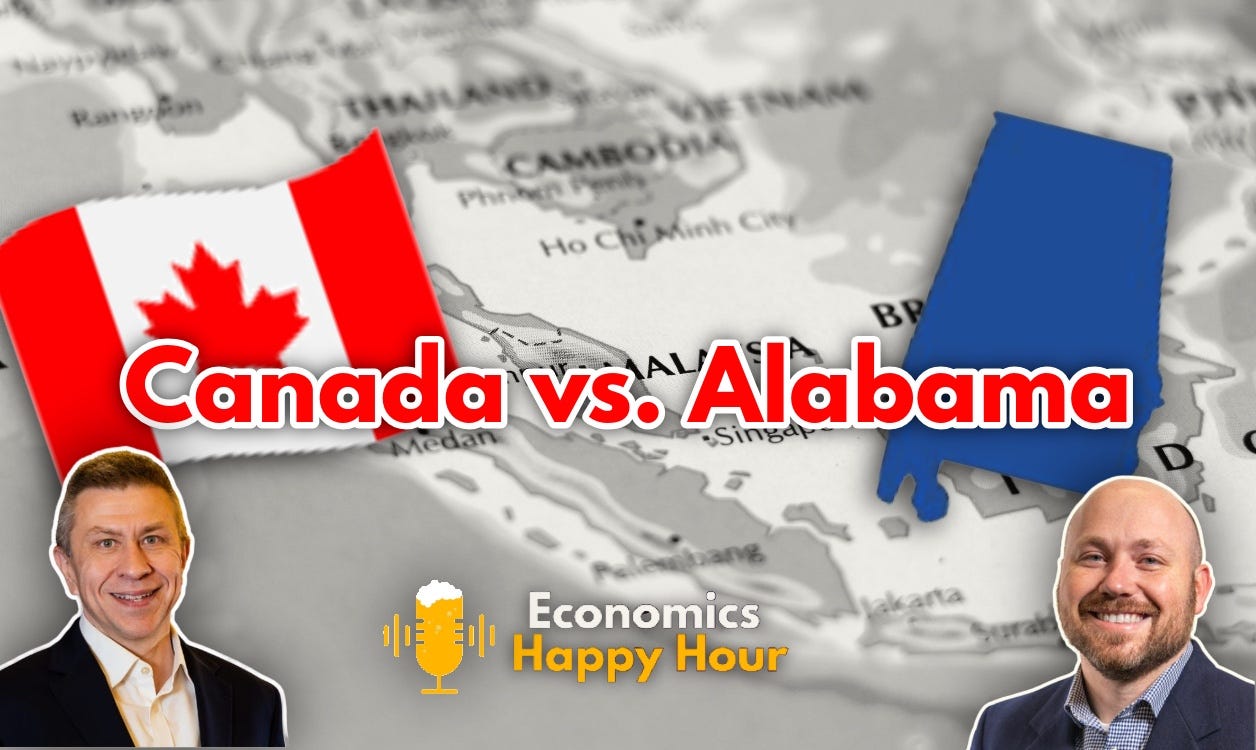
A recent headline claimed that Canada’s GDP per capita has fallen below Alabama’s. That sparked a broader conversation about what GDP per capita actually measures and why it can change in surprising ways. We explored possible explanations, including immigration patterns, post-pandemic growth differences, and policy environments. Along the way, we asked a bigger question: what really drives long-run economic growth?
In this episode, we talk about:
Why GDP per capita in Canada now trails Alabama’s
The difference between GDP per capita and median income
How immigration can lower averages even if individuals are better off
Why U.S. GDP per capita has grown steadily since 2020 while Canada, Germany, and the U.K. have stalled
Whether pro-growth business climates actually explain the recent divergence
How stereotypes about “poor” regions can lag behind economic reality
If you liked this conversation, you might also enjoy
Show notes & references
We’re nearing the halfway point of the semester, which is a great time to check in with each other. Matt has been working on international initiatives, and Jadrian has been deep in the redesign of his sports economics course. For drinks this week, Matt just returned from a trip to Cyprus and brought back a Shockwave Pale Ale from a small bottle shop. Unfortunately, the pint glass didn’t survive the trip home. Jadrian opted for a Blackberry Lemon Shandy from Rusty Rail, courtesy of a friend in State College.
Our data point challenge this episode started with how long it’s been since the U.S. men’s hockey team last won gold at the Winter Olympics. Matt followed that up with two numbers that sparked today’s main topic: Canada’s GDP per capita compared to Alabama’s.

From there, we unpacked what GDP per capita actually measures. It’s an average, and averages can move in ways that don’t always reflect individual well-being. We compared this to U.S. median household income data from FRED, which can tell a very different story than GDP per capita. The distinction between median and average matters, especially when population changes are involved.
We also looked at recent trends across other developed economies. While U.S. GDP per capita has steadily increased since the pandemic dip, Germany and Canada both saw initial rebounds followed by declines in the past few years. The United Kingdom experienced a similar bounce but has been largely flat more recently. That raises a broader question: what explains the divergence?
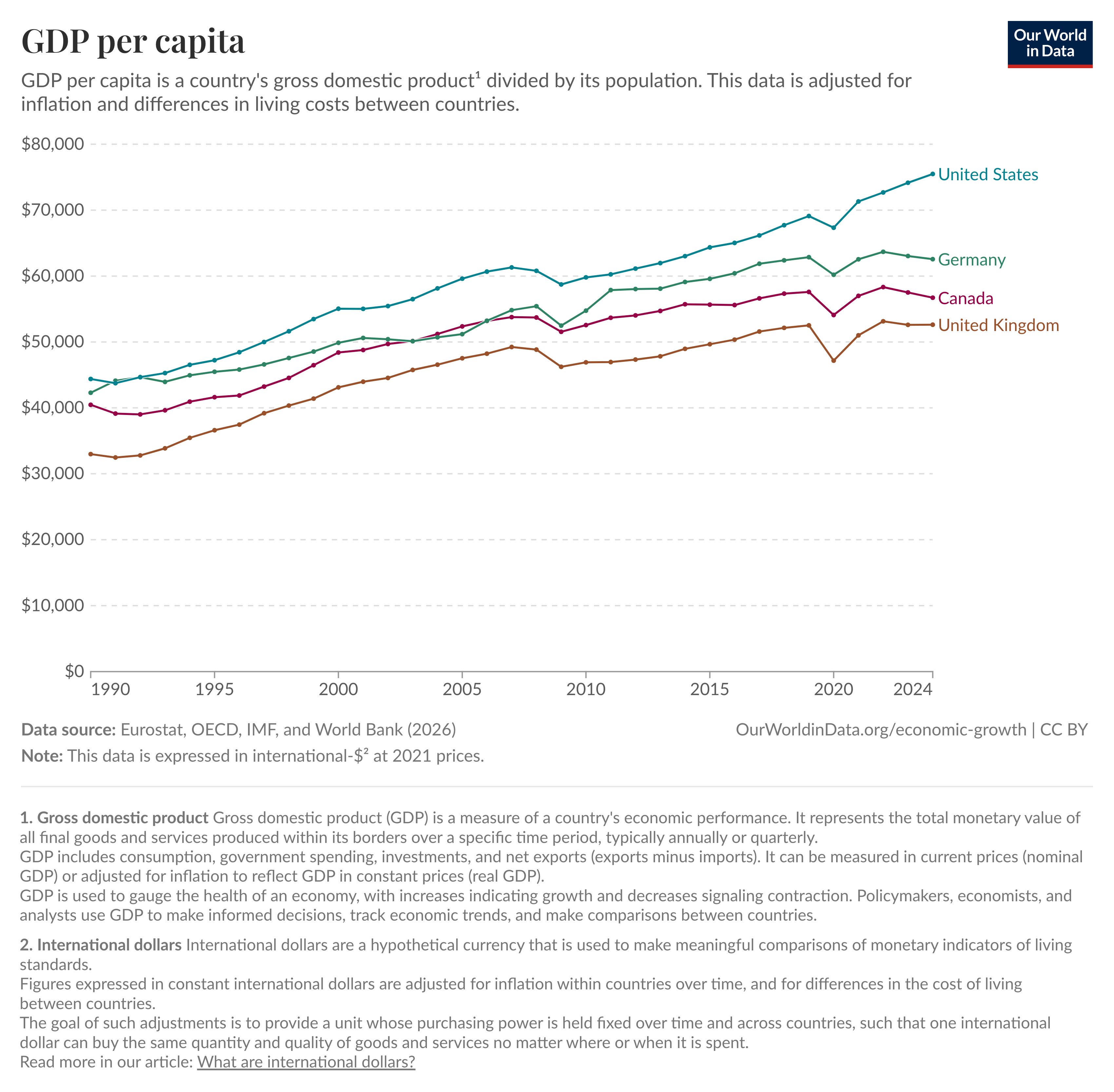
So what can (and can’t) GDP per capita tell us about well-being? There’s a straightforward “math story” here. Even if everyone in a country is better off than they were before, averages can fall if the population grows quickly and new workers enter at lower wages. True statistics can still be interpreted in misleading ways.
We also spent time discussing two popular measures of economic freedom: one from the Heritage Foundation and another from the Fraser Institute. According to the Heritage Foundation’s index, Canada has ranked higher than the U.S. in recent years. That gap may be influenced in part by trade policy uncertainty in the United States, though the full story is more nuanced.

While much of our focus was on what might be happening in Canada, we also asked whether Alabama deserves more credit. Cities like Huntsville have worked hard to attract business investment and lower unemployment. The authors of the original article traveled to Alabama expecting one story and came away with another. Stereotypes about regions can linger long after the underlying data changes.
If you’re in Canada or Alabama (or Germany, or the U.K.), we’d love to hear your perspective. What are we missing?
Pop Culture Corner 🍿
Matt brought up an example of creative destruction, one of the key forces behind long-run income growth. In a classic Friends episode, Joey flips through the Yellow Pages to find a guitar instructor. At the time, those thick books were a household staple. Today, they’re mostly obsolete, replaced by web searches, Yelp, and online directories.
Jadrian chose a classic South Park episode that a graduate student recently shared with him. In the scene, immigrants from the future arrive in town and begin undercutting local wages. Residents storm a city council meeting to complain that the newcomers are “taking their jobs” and demand action. It’s exaggerated, but it highlights a real economic tension around immigration, wage competition, and public perception.
Have a question or topic idea? Reply to this email or drop it in the comments!


